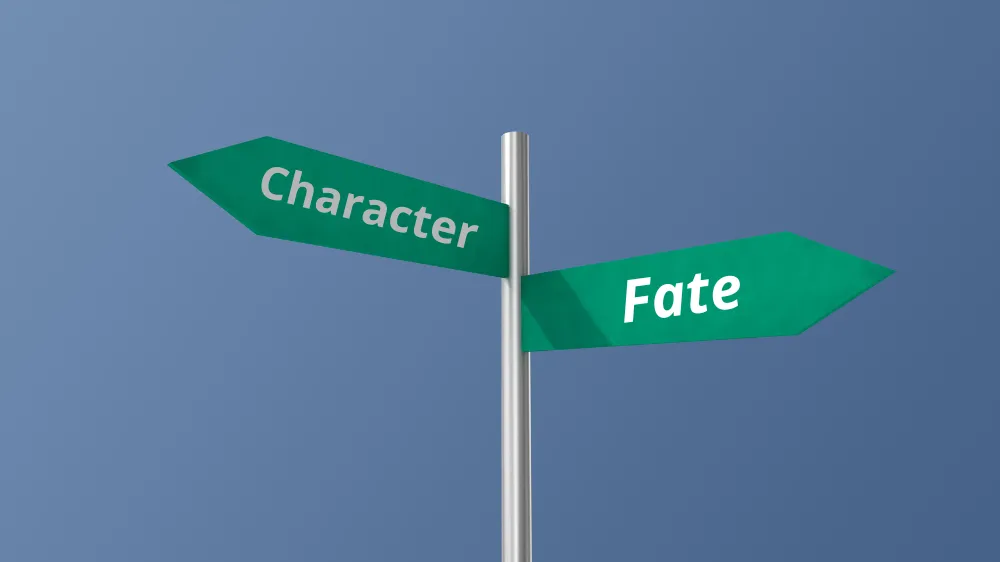
Two ways to read the same chart
A modern astrologer, taking your chart, most often sets about describing your personality: strengths and weaknesses, talents, how you show love, which partner “suits” you. At the end you know a little more about yourself — but nothing new about your fate.
A forecaster reads the same chart differently. His interest is not in what kind of person you are, but in what will happen to you. He reads your horoscope as a map of fate, not a map of personality.
These are not two levels of mastery — they are two different approaches to one instrument. And the answer depends on which one you have come to.
Character changes with time. Fate is constant.
Character describes how you will show yourself in a given moment. Who you were at five and who you will be at eighty are two different expressions, two different people. What is more, your character does not tell you what will happen to you, or when.
A person with a “difficult character” may live a calm life — because his fate is kind to him. And the reverse: a charming, easy person may fall into the same harsh situations time after time — dismissals, betrayals, ruined relationships — not because he is bad, but because his natal chart carries a persistent pattern that the stars set off from time to time. Character has nothing to do with it; what matters here is the pattern of fate.
It is exactly these patterns — the persistent scenarios of a life — that a forecaster looks for in a chart, alongside future events.
How the stars shape fate: imprint and trigger
To read fate, one has to understand how it takes shape.
According to Jean-Baptiste Morin, the last European forecasting astrologer of the 17th century, at the moment of birth the radiation of deep space, having passed through the planets at their stations, leaves an imprint in a person. This imprint lays down a set of future reactions and patterns of response, by which the person then commits unconscious actions that lead to known consequences.
For a time these celestial imprints stay silent and show nothing. But as life goes on, the planetary configurations react to them — and set off the chains of unconscious action that quietly lead the person toward a known event. The body and brain of a person born with a celestial imprint are the vessel of fate; the planets are what sets it in motion.
How fatalistic a chart is
There is a familiar argument — “the stars determine everything” against “everything is in your hands”. In predictive practice it is settled simply: the truth lies in the middle.
There are more fatalistic charts: in them the planetary imprint is clear enough, and the triggering configurations are strong. In such cases a persistent life pattern will follow a person almost regardless of his will. But even then, knowing the future consequences in advance, one can take measures to prevent harm or to raise the chance of a favorable event. That is what a forecaster is for — to advise in which direction, and above all at which precise time, effort should be made in advance.
There are less fatalistic charts: the celestial imprint is there, but it has no clear direction. The stellar configuration can, with equal probability, mean different ways of living out a fate. In such cases a person is more subject to the will of blind chance than to his horoscope. Here a forecaster can only outline alternative ways of living through a given period of life, since the natal chart admits several possible variants at once.
Context decides everything: one chart — different fates
The last thing without which the reading of fate would turn into dogma is the context of real circumstances. The same chart, applied to different life circumstances, yields different fates in the end.
A classic example is twins born minutes apart: the charts are nearly identical, yet the lives can differ a great deal — not because the stars look on them differently, but because context — random factors, sudden circumstances — creates different conditions of life. Acting identically at the same time, but in different circumstances, two people will arrive at different final events.
So a forecaster never reads a chart “in the abstract”. He reads it in the context of your real life — what has already happened to you and what is going on around you. Without context the chart is mute; with context it speaks.
What you get from a chart reading with a forecaster
A natal chart reading with a forecaster is not a portrait of character. It is:
- a map of your persistent fate patterns;
- an astrological explanation of why those patterns are so strongly expressed;
- a separation of life spheres into those more fixed by the stars and those more open to chance.
Character is what you already know about yourself. Fate is what makes a chart worth reading.
You can learn the persistent patterns of your fate — and see which are fixed and which are open to your will — in a natal chart reading with a forecaster. It is an online consultation over Zoom; forecasting future events is a separate service.