
Published in Correlation — The Astrological Association Journal of Research in Astrology, 38(2), 2026, pp. 89–102. Author’s note (October 2026). This is the corrected blog version of the article. A post-publication audit of the study code identified factual clarifications, applied throughout this text; the journal version remains as published. Data and code for reproducing the experiment are available as code on GitHub.
Abstract
Primary directions are a predictive technique used to determine the timing of future events. This study presents a statistical test of their validity in predicting violent death, using a sample from the AstroDataBank database with high-quality birth data (Rodden Rating AA). We evaluated the effectiveness of primary directions in the style of J.B. Morinus, focusing exclusively on a computer model of the most severe “fatal directions” explained below.
A case was considered positive if death occurred within a 180-day window of such a direction. Using a Monte Carlo simulation, we compared the observed coincidence rate against the null hypothesis of random distribution. Based on a pilot study, we set a target effect size of relative risk RR = 1.15 (a 15% increase over chance) and powered the study accordingly with a final sample of 400 charts.
The analysis yielded a non-significant result (p-value = 0.11), providing no statistical evidence that violent death consistently coincides with the most severe primary directions as defined by our model. This null finding suggests that the relationship is more complex than a direct trigger.
While the results support the null hypothesis that no significant effect was detected, the direction of the result (p = .11) means that we cannot rule out the possibility of a minute effect. Such an effect might be enhanced when combined with additional techniques or assessed within a more comprehensive astrological framework.
The study establishes a methodological framework for future research, which could benefit from a more nuanced, expert-led analysis incorporating a broader set of astrological factors.
Predictive Technique to be Examined
Primary Directions
Although previous studies have attempted to statistically investigate potential associations between astrological factors and violent death (Dean & Maher, 1977; Press, 1978), the present work focuses specifically on the predictive technique known as primary directions, evaluating whether the timing indicated by them has any statistical association with instances of violent death.
Directions constitute one of the oldest and most technically demanding methods of astrological time determination. In its classical form, the technique is outlined by Claudius Ptolemy in Tetrabiblos III.11, where directions are calculated on the basis of semi-arcs and the rotation of the celestial sphere. From Late Antiquity through the medieval period, this semi-arc method remained the dominant computational framework.
During the Renaissance, alternative geometrical formulations emerged. Of particular importance is the method employing poles and circles of position, later associated with the system of Regiomontanus (Regiomontanus, 1490). Although anticipations of this construction can be found in earlier Arabic sources (notably al-Jayyānī in his “Risāla fī irsāl al-ašwāq”, Hogendijk 1986), it was Regiomontanus who systematized and popularized this approach in 15th-century Europe. The present study employs this Regiomontanian method of directing by circles of position. It must be noted that its chronological results may differ—sometimes by several years—from those obtained by the Ptolemaic semi-arc method, except in the case of direct directions to the angles, where the two methods coincide.
The designation “primary directions” itself is historically late. The qualifier primary was introduced by Placido de Titi in the 17th century (Placidus, 1650) and was not used by Jean-Baptiste Morin, whose system of directions is nevertheless fully grounded in the doctrine of the primary motion. Given the subsequent proliferation of other directional techniques (secondary directions, solar arc directions, etc.), the term “primary directions” has become standard in modern scholarship and is therefore retained here for clarity.
Geometrically, primary directions represent a spatial conjunction formed through the rotation of the celestial sphere. All directions are based on the natural primary motion of the heavens from east to west. In the Regiomontanian construction, the operative geometry is defined by the intersection of the moving celestial sphere with a circle of position—a great circle passing through the celestial poles and the point under consideration (represented by a green line).
For computational purposes, one point is treated as moving (the orange dot) and the other as fixed (the yellow dot). These points are called promissor and significator.
The terminology of significator and promissor requires historical qualification. In early modern usage, a significator denoted a point signifying a given sphere of life (shown by the astrological house), while a promissor designated a point promising the manifestation of a specific event in that sphere, whether beneficial or adverse.
In direct directions, the significator is geometrically fixed while the promissor advances toward its circle of position along the primary motion. If the arc separating the promissor from the significator exceeds 180 degrees, the computational roles of the two points are exchanged: the significator becomes the moving point and the promissor the fixed one. This procedure has traditionally been termed a “converse” direction.
It is essential, however, to clarify that this reversal concerns only the geometrical treatment of the points and does not imply a reversal of the celestial motion itself. Even in so-called converse directions, the rotation of the sphere remains east-to-west. In such cases, the moving significator is directed toward the fixed promissor, while the cosmological basis of the operation—the single natural primary motion—remains unchanged. This clarification accords with Morin’s critique of the traditional distinction between “direct” and “converse” directions, which he regarded as artificial insofar as all directions depend on the same primary rotation (Morinus 1661).
In practical application, significators are typically chosen among planets or house cusps corresponding to the sphere of life under investigation. The promissor, by contrast, signifies the operative factor whose directed contact with the significator marks the potential temporal activation of the natal promise.
Aspects and antiscia (i.e. intersection of the planet’s diurnal arc with the plane of the ecliptic) of other planets in the horoscope are typically used as promissors. The promissor carries the promise of an event related to various spheres of life, meaning different houses and their significators. For example, suppose:
- Libra is on the cusp of the 7th house, so Venus rules the 7th house of marriage and is itself located in the 12th house of illnesses.
- Its unfavourable aspect1 relative to the 2nd house of money causes financial loss due to a spouse.
- This same unfavourable aspect relative to the 1st house of health causes an illness of Venus’s nature.
From the perspective of primary directions, this looks like the following:
- Financial loss due to a spouse: The unfavourable aspect of Venus is directed to the significator of the 2nd house, for example, to the ruler of the 2nd house.
- Onset of illness: The unfavourable aspect of Venus is directed to the significator of the 1st house, for example, to the Ascendant (ASC).
Fatal Directions
According to Morinus, the following combinations of promissors and significators create potentially fatal directions:
- Promissors of death directed to the significators of the 1st and 10th houses (life and activity)
- Unfavourable promissors of life and activity directed to the significators of the 8th house
- Promissors of death directed to the significators of the 8th house
A person’s life may feature multiple fatal directions formed by these combinations.
Promissors of Death
According to Astrologia Gallica (Morinus, 1661) the promissors of death are as follows:
- Planets in the 8th or 2nd house, and their adverse aspects and antiscia. An exception is made for benefic planets in strong essential dignities in the 8th house, which, on the contrary, protect from death.
- The rulers of the 8th house by sign or exaltation, as well as their adverse aspects. An exception is made for the bodily position of benefic planets in strong essential dignities, which protect from death.
- Adverse aspects or the bodily position of any planet that casts an unfavourable aspect to the cusp of the 8th house. An exception is made for malefic planets. Any of their aspects, as well as their bodily position, can signify death regardless of the malefic’s celestial condition or the nature of its aspect. In the model implemented for this study, this exception is applied to Mars alone — the natural ruler of violent death.
- Mars, as the ruler of violent death, as well as its aspects and antiscia.
Unfavourable Promissors of Life and Activity
The following points of the natal chart strongly indicate dangerous periods in life and activity, especially if they fall in the 8th house or form a conjunction with its ruler:
- Planets in the angular houses, and their adverse aspects and antiscia.
- The rulers of the 1st or 10th houses by sign or exaltation, as well as their adverse aspects.
Significators of the 1st, 10th, and 8th Houses
- Planets in the 1st house, the ruler of the 1st house, and the Ascendant (ASC)
- Planets in the 10th house, the ruler of the 10th house, and the Midheaven (MC)
- Planets in the 8th house, the ruler of the 8th house, and the cusp of the 8th house.
- Mars, as the natural significator of violent death.
The Concept of Favourable and Adverse Aspects
According to Morinus, a planetary aspect should be considered as its invisible counterpart, positioned at a specific degree similar to an antiscion.
The final action of an aspect is determined by:
- The condition of the aspecting planet
- The type of aspect (see Borealis, 2024)
- The sign and house where the aspect falls, as well as
- The condition of the aspect’s dispositor.
Consider a simple example. Suppose Jupiter casts a square into the sign of Cancer. The square gathers Jupiter’s worst qualities. For simplicity, let’s assume Jupiter has dignity by triplicity, does not rule any malefic houses, and carries no negative connotations. In this case, the square would simply create a neutral copy of Jupiter, devoid of any dignities.
On the other hand, this copy falls into the sign of Cancer—the place of Jupiter’s exaltation. From this moment, the copy of Jupiter begins to exert a positive influence, despite being a square.
The condition of the aspect’s dispositor is also considered. For instance, a square from Jupiter falling in Cancer will be less beneficial with the Moon in Scorpio and more constructive with the Moon in Taurus.
Assessing the condition of the aspecting planet involves more subtle parameters, such as a weighted sum of the favourable and adverse aspects it receives from other planets, the condition of its dispositor, and the beneficial or malefic nature of the house it occupies or rules.
Antiscia act similarly to aspects, with the only difference being that antiscia, unlike aspects, have no specific form that could accumulate the best or worst qualities of a planet. Therefore, antiscia simply create “invisible copies” of planets (in terms of their astrological influence).
In our research, however, when evaluating promissors (i.e., planetary aspects and antiscia), we used a highly simplified quantitative model based on Morinus’s logic, considering only major dignities and debilities and excluding secondary evaluative factors (see Appendix 3 for details). This allowed us to automate the process of identifying fatal directions.
It must be emphasised that this simplification is not merely a practical convenience but also means that the present study evaluates only selected, and arguably the most prominent, components of Morinus’s system rather than the doctrine in its entirety.
According to Morin (Astrologia Gallica, Book XVII), no astrological placement acts alone—that is, no single placement can produce the effect that only the joint action of all can.
The omitted elements—including the condition of the dispositor, triplicities, and related factors—while generally secondary in importance, remain part of the broader doctrinal framework. Consequently, the present model represents a simplified proxy of the Morinian method rather than a complete implementation of it.
Timing in Primary Directions
The number of degrees in the directional arc approximately equals the number of years from birth until the event. For a precise conversion of degrees into years of life, a coefficient of 365.24/360 ≈ 1.0146, known as the Naibod key, is used (Naibod, 1560).
In primary directions constructed in the Morinus plane (Appendix 2), the typical deviation between a predicted and actual event is up to half a year. Therefore, we define a death as coinciding with a fatal direction if it occurs within a ±180-day tolerance window of the direction’s perfection.
Severe Fatal Directions
With such a broad definition, fatal directions occur almost every year, making the probability of dying during one theoretically approach 1.0 and thereby greatly reducing the discriminative value of the criterion.
To determine which primary directions can signify death, traditional astrology developed a well-defined doctrine centered on the hyleg (apheta) and the anareta, as described by Claudius Ptolemy (Tetrabiblos III.10–11) and elaborated by subsequent ancient and medieval authors. Within this framework, the direction of the anaretic planet to the hyleg, or to its significators, constituted the principal temporal indicator of death. This doctrine remained standard throughout the medieval period and was regarded as authoritative by most traditional practitioners.
Jean-Baptiste Morin, however, explicitly rejected the hyleg–anareta model, arguing that it imposed an artificial hierarchy upon the chart and failed to account for the totality of its causal structure. In place of this doctrine, Morin proposed a more global evaluative approach in which the entire configuration of the natal promise and its directed activations must be considered. The present study adopts Morin’s methodological framework rather than the classical hylegical model. Accordingly, the criteria outlined below should be understood as belonging specifically to the Morinian tradition and not as representative of the dominant historical doctrine.
Within this framework, practitioners have sought to identify those directions whose promissors carry the strongest destructive potential. These include adverse aspects and antiscia involving planets connected with the 1st house (life and bodily integrity), the 8th house (death), and the 10th house (actions and public manifestation), especially when such planets are already severely afflicted in the natal configuration.
At the same time, an important qualification must be introduced. Even within Morin’s system, the temporal sequence of directions is a major consideration. A direction judged sufficient in principle to cause death cannot be dismissed merely because a more severe direction occurs at a later age. If a destructive direction perfects at age 40 or 60, Morin would not have considered it incapable of producing death solely on the grounds that an even stronger direction perfects at age 80. The chronological unfolding of directions remains decisive.
However, for the purposes of statistical investigation, an additional methodological constraint becomes necessary. There exists a conceptual distinction between directions that can permit death and those that clearly and emphatically promise it. If all directions theoretically sufficient to produce death were included in the dataset, the statistical problem would become intractable: in many charts, at least one potentially lethal direction can be identified for nearly every year of life. Meaningful differentiation would then require further astrological filtration through solar revolutions, lunar revolutions, and transits—techniques that introduce substantial interpretative complexity and are difficult to formalize or automate in large-scale quantitative research.
For this reason, the present study does not include all directions that could theoretically indicate death. Instead, it restricts the analysis to a narrowly defined subset of directions that satisfy two conditions simultaneously: (1) they involve the principal significators of death, and (2) they exhibit the highest calculated destructive strength according to the simplified assessment model described in Appendix 3. Specifically:
- We focus on directions where the significators of death carry the most destructive potential—that is, the most adverse aspects and antiscia involving planets related to the 1st, 8th, and 10th houses.
- We do not single out from the general list those directions that are reinforced by solar and lunar returns that also portend death for the same year and month.
- Finally, we do not consider the context, although it means a lot. If a direction signifies a violent death, but the individual is in safe circumstances, that direction may not manifest the event—the conditions of the current year take precedence over the chart’s indications.
- We do not incorporate the full evaluative framework for assessing planetary condition—including minor factors like triplicities, the condition of the dispositor—even though these factors are doctrinally essential for determining whether a direction actually produces its promised effect.
The application of these criteria reduces a large set of potentially death-related directions to a relatively small subset of highly destructive configurations. Such directions typically occur only once every several years, although their frequency varies between horoscopes. Throughout this study, the term severe fatal direction refers exclusively to this restricted class of directions.
Statistical Methodology
Probability of Death under the Null Hypothesis
Under H₀, death is assumed to occur randomly. The probability that death randomly coincides with a primary direction is the proportion of a person’s life spent under the influence of such directions.
We define the total time of elevated risk for an individual as:
where is the number of fatal directions perfected at , and days. Overlapping intervals are merged.
Thus, if we denote the length of life as , the probability of a random coincidence for a single chart is:
Here is individual for each horoscope.
Let be a discrete random variable that can take two values, 0 and 1, where 1 indicates that death randomly occurred during the risk period defined by primary directions. The expected value of this random variable is then .
Considering horoscopes, we obtain a set of probabilities for observing death during fatal directions across individuals. The sum of these probabilities gives the expected number of such random coincidences under the null hypothesis:
This value represents the expected number of deaths that would randomly coincide with the active period of primary directions across the entire sample of horoscopes.
Probability of Death under the Alternative Hypothesis & Effect Size Estimation
Under H₁, the probability of death during a fatal direction is:
where is the relative risk — the measure of effect size in this experiment.
Target Effect Size
For small values of , the effect is weak and requires a large sample. For higher , the sample size can be smaller; however, very large values on small samples may be due to random fluctuation.
Prior reliable estimates for were absent from the literature. We conducted a pilot analysis of 100 charts solely to calibrate realistic expectations. These 100 charts were intended to be excluded from the final test sample to avoid data leakage (see the author’s note: the exclusion did not fully take effect).
The pilot data indicated that observed effects were compatible with a range around RR ≈ 1.1. This suggested that strong effects (RR = 2–3) were unlikely.
Based on this, we set the minimum effect size of interest at RR = 1.15. This value represents:
- A moderate yet practically significant 15% increase over randomness.
- A realistic target for method validation, consistent with pilot data.
- A conservative criterion: if the method cannot demonstrate predictive power at this level, its practical utility is questionable.
Estimation Algorithm
The following procedure was used for the pilot analysis of 100 charts.
Step 1. A list of probabilities for random death during fatal directions was constructed, along with a list of observed outcomes , where 1 indicates that death occurred during a fatal direction.
Step 2. Bootstrap samples (with replacement) of size were generated from both and . For each bootstrap sample, the expected number of random coincidences and the observed number of deaths were computed.
The relative risk was estimated as:
Step 3. Step 2 was repeated 10,000 times to obtain the distribution of . The 2.5th and 97.5th percentiles of this distribution were taken as the 95% confidence interval. If the interval was narrow, the median was used as the point estimate; if wide, the lower bound was used as a conservative estimate:
Thus, the estimated probabilities of death during fatal directions under the alternative hypothesis were obtained as:
Controlling Type I Error
To avoid detecting a false effect (when no effect exists), we set the significance level at . Data are considered statistically significant when the p-value ≤ 0.05.
Controlling Type II Error
To reduce the probability of missing a true effect (failing to reject when is true), we determine the minimum number of horoscopes required for the statistical power to exceed 80% according to the algorithm explained in Appendix 4.
Approach to the Problem
- A pilot sample of 100 “Accidental Death” charts (Rodden AA) was analysed.
- This pilot was used to determine the range of realistic expectations for .
- Using the pilot sample’s distribution and the target RR = 1.154, we calculated the minimum sample size required for 80% power.
- A new sample of 400 charts was randomly selected from AstroDataBank (intended to exclude the pilot data; see the author’s note).
- The standard Monte Carlo simulation (Appendix 1) was used to compute the final p-value.
- If p ≤ 0.05, reject H₀. If p > 0.05, we fail to reject H₀.
Results
The bootstrap simulation for power calculation yielded the following results:
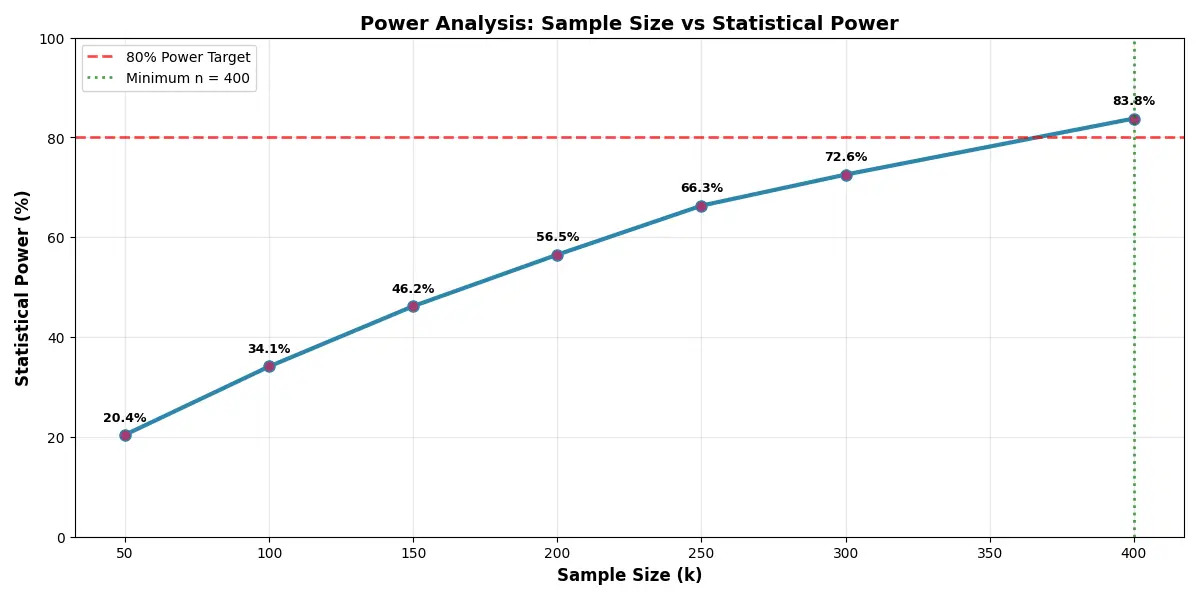
For a sample size of 400 horoscopes, we achieve a power of 80% or more. Therefore, a final sample of 400 horoscopes was selected. The Monte Carlo simulation on this sample yielded a p-value of 0.11.
Since the p-value (0.11) exceeds the significance level (α = 0.05), we fail to reject the null hypothesis. This indicates a lack of statistical evidence to conclude that deaths from accidental causes occur non-randomly with respect to the severe primary directions defined by our simplified computer model.
Additional Verification
Since the computations were performed using graphics cards, our processing capabilities allowed us to use an even larger sample to estimate the relative risk RR. Of the 19,693 charts of individuals born after 1900 in the source database, 1,103 record a violent death; 1,102 of them were usable (one chart was excluded because its recorded death date coincides with the birth date). We therefore performed a control bootstrap simulation using all 1,102 horoscopes, running 1 million iterations in the simulation.
The result of the estimation for the true RR is shown in the figure below:
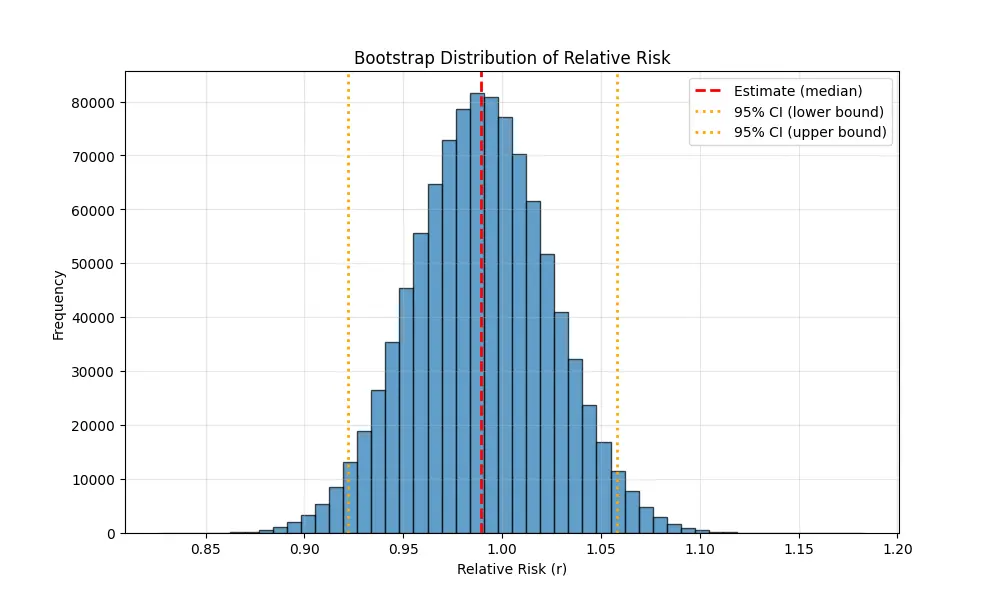
We can see that with larger sample sizes, RR predictably tends towards one, meaning the number of deaths occurring during active fatal directions equals the number of random deaths during the same periods.
Conclusion & Discussion
This study presents a rigorous methodological framework for statistically testing the predictive power of primary directions, specifically focusing on violent deaths and using a highly stringent astrological model.
The core finding is that the simplified, automated model tested here—one that deliberately omits key evaluative variables of the Morinian doctrine—fails to predict violent death at a statistically significant level. This null result applies specifically to the truncated model and does not constitute evidence against the Morinian method of primary directions as a whole. One cannot test a historically nuanced technique whilst simultaneously discarding the variables that make it function.
More broadly, this finding highlights the importance of evaluating astrological forecasting systems as integrated doctrinal frameworks rather than reducing them to isolated techniques, even when those techniques represent the most prominent or influential components of the system.
However, another critical consideration additionally frames this null result: inaccuracies in AstroDataBank data, which have been studied previously (Oshop 2018), present a significant issue. An error of just a few minutes in the birth time can lead to a shift of up to six months in the predicted date of an event when directing to a house cusp. The AA accuracy rating indicates only that the recorded birth time was derived from a birth certificate or comparable official document; it does not guarantee that the time itself is free from rounding or clerical standardization. Official records in certain jurisdictions may reflect birth times rounded to the nearest half-hour or hour, or otherwise standardized according to administrative practice. Consequently, the AA designation should not be interpreted as a certification of astronomical precision.
A Methodological Starting Point
This research should be viewed as a foundational step towards a more robust validation paradigm. The failure of this stringent model to show a significant effect does not invalidate the entire method of primary directions. Instead, it suggests that the reality is more complex than “the most severe direction equals death.” It is crucial to acknowledge that traditional, manual practice inherently includes a critical step absent in our automated model: chart rectification.
It has been objected that rectification is epistemologically incompatible with the broad temporal windows used in directional analysis: if a single event manifests within a ±180-day window, one cannot use that same event to retroactively pinpoint a birth time to the minute. This objection, however, rests on the implicit assumption that rectification operates on a single event within a single directional interval. In practice, rectification exploits the fact that a change of even one minute in the birth time shifts all directional arcs by several months, thereby producing a distinctly different chronological pattern of predicted events. By comparing the ensemble of life events—marriages, career changes, illnesses, relocations—against the full set of directional intervals simultaneously, the astrologer identifies the birth time whose pattern of intervals best matches the observed chronology. It is the convergence of multiple events on a single birth-time hypothesis, not the precision of any single event-to-direction match, that makes rectification possible. A single ±180-day window is indeed too coarse for minute-level precision; but the intersection of multiple such windows, each shifted differently by a one-minute change in birth data, narrows the solution to a unique value.
An analogy may clarify this: a single blurred spectral line cannot determine a radio frequency with precision, but the alignment of multiple blurred lines at consistent intervals can. Similarly, rectification achieves its precision not from the sharpness of any one biological or accidental event, but from the coherence of the entire pattern.
Nevertheless, rectification as traditionally practiced is a manual, interpretive process, and its formalisation for large-scale statistical research remains an open challenge. Future work should investigate whether automated or semi-automated rectification procedures, validated against independently recorded birth times, can improve the predictive performance of primary direction models.
The Path Forward
To achieve greater accuracy, a future study on a similar scale (400+ charts) would benefit immensely from a manual, expert analysis of each chart. This process would inherently include rectification prior to prognosis, aligning the natal chart more accurately with the individual’s life narrative. While labour intensive, this would allow for the application of traditional, holistic astrological judgment, potentially yielding a different and more nuanced result. Our work establishes the statistical groundwork upon which such a labour-intensive, expert-driven study—one that mirrors the traditional practice of rectification—could be built and evaluated.
In summary, this article offers a validated methodological approach for testing primary directions. The specific finding—that a model based solely on the most severe directions does not predict accidental death—is a significant contribution in itself. It shifts the question from “Do the worst directions cause death?” to the more sophisticated “Under what specific astrological conditions, if any, can death be predicted?” This opens the door for more refined and comprehensive research in the future, which must seriously contend with the essential role of chart rectification.
Appendix 1. Monte Carlo Simulation
To evaluate the p-value via Monte Carlo simulation:
Step 1. Based on the probabilities , simulate outcomes under the null hypothesis :
where .
Thus, we obtain a simulated array .
The total number of deaths in this simulation is
Step 2. Repeat Step 1 ten thousand times and count the number of cases where , i.e., where simulated coincidences equal or exceed the observed number.
Step 3. The empirical p-value is then estimated as
Appendix 2. Primary Directions in the Style of Morinus
A distinctive feature of primary directions in the Morinus style is the plane used for constructing aspects to determine the significator’s coordinates. Morinus considered the segment of a planet’s path (P) between two successive nodes. In the figure below, the blue line represents the apparent motion of the planets, including the nodes, on a three-dimensional sphere.
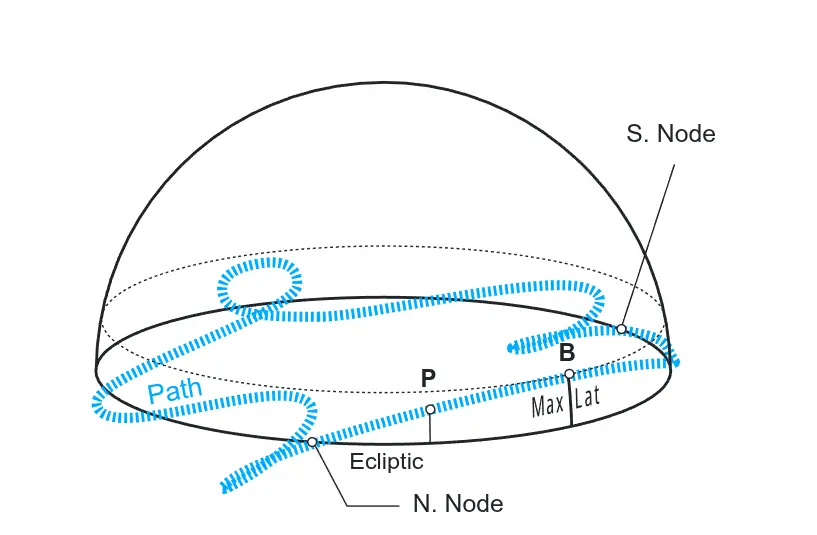
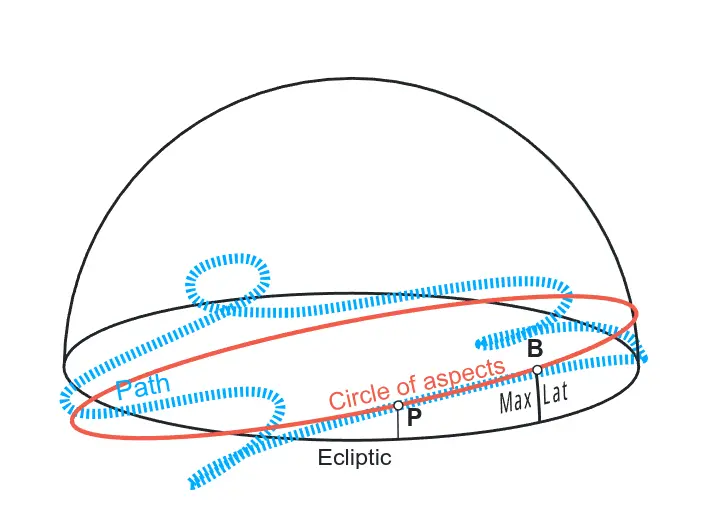
Morinus then calculated the local extremum of the planet’s path on this segment (point B in the figure above). He used the latitude of this local extremum as the inclination angle for the circle of aspects.
Appendix 3. Direction Assessment Algorithm
Quantitative Simplified Assessment of Direction Strength
To evaluate the destructive or constructive power of an aspect, we implemented a simplified model following Morinus’s logic:
Initial Assessment of Planetary Dignity or Debility: We first evaluate a planet’s strength or weakness using only major dignity indicators.
- A planet in its own sign (domicile) or in its sign of exaltation is assigned +5 and +4 points of virtue, respectively.
- A planet in its sign of exile (detriment) or fall has −5 and −4 points of virtue, respectively.
- We do not consider minor or intermediate indicators such as triplicity, term, face, the influence of a close aspect, the condition of the dispositor, or the planet’s intrinsic benefic or malefic nature. This simplification prevents the calculations from becoming overly cumbersome, allowing us to focus on the most prominent dignities and debilities.
Application of Morinus’s Logic to Aspects
It should be clarified that the present algorithm represents a methodological simplification of Morin’s doctrine rather than a complete reproduction of his evaluative procedure. Morin discusses minor aspects such as the semi-sextile and quincunx in theoretical terms (Book XVIII), acknowledging their existence but attributing to them comparatively weak efficacy. In his numerous worked examples, however, these minor aspects are not assigned decisive weight in determining major events. For the purposes of statistical modeling, we have therefore restricted the analysis to the major aspects (conjunction, sextile, square, trine, opposition), as these consistently constitute the operative framework in Morin’s practical demonstrations. The omission of minor aspects thus reflects both their relatively subordinate role in Morin’s applied methodology and the need to maintain computational clarity.
- An aspect of a favourable nature (trine, sextile) concentrates the planet’s positive qualities. For example, a trine cast by a planet in its detriment creates a neutral counterpart of that planet (0 virtue points). A trine cast by a planet in its exaltation creates an exalted planetary counterpart at the aspect’s location (+4 virtue points).
- Conversely, an aspect of an unfavourable nature (opposition, square) concentrates exclusively the planet’s negative qualities. A square from the Moon in Cancer (its domicile) creates a neutral counterpart of the Moon (0 points). A square from Mars in Cancer (its fall) creates a destructive counterpart of Mars (−4 points).
- We then account for the sign where the aspect falls. If a square from Mars in Cancer (−4 points) falls in Aries, where Mars has +5 points of strength (domicile), the combined effect of this aspect is evaluated at +1 point. Thus, the aspect is considered moderately constructive.
Final Filtering: For the purposes of this study, we only considered destructive aspects whose calculated strength of destruction reached a threshold of −3 points (i.e., scores of −3 or lower). (Author’s note: the journal version contains a typo here — a threshold of −5 points.)
Antiscia Calculation: In this simplified model, planetary antiscia are calculated in a similar manner. The key difference is that, unlike aspects, antiscia do not modify the “invisible counterpart” of the planet positioned at the antiscion degree. The dignity/debility score of the original planet is simply projected.
Mathematical Calculation of Directions
For the mathematical computation of primary directions, including the positions of promissors and the length of their paths, we employed formulas from spherical geometry.
All computations were performed using the Python programming language. The complete set of the model’s numerical parameters — per-planet orbs, conjunction tolerances, and the activity window — is documented in the companion code repository.
Appendix 4. Algorithm for Controlling Type II Error
Step 1. Different sample sizes were considered: , with the procedure stopping at the first reaching the 80% power target ().
Step 2. For each :
- A bootstrap sample (with replacement) was created from the 100 pilot values
- Values were computed, where
- Outcomes under were simulated: if and if , where was independently generated for each
- The total observed number of deaths was computed
- Using Monte Carlo simulation on the array , the empirical p-value for this was computed
Step 3.
- Step 2 was repeated 10,000 times, counting how often the p-value ≤ 0.05
- This count was divided by 10,000 to estimate the power at sample size
Step 4. This process was repeated until the power exceeded 80%, yielding the minimum number of charts required to control Type II error.
References
- Morinus J.-B. (1661) Astrologia Gallica, Book 21. Hagae.
- Oshop R (2018), Even AA Rating Charts in Astro-Databank of People Born After 1930 Are Highly Likely to be Wrong. Blog post at www.ayurastro.com.
- Borealis A (2024). The Effect of Aspect. Blog post at morinus-astrology.com/effect-aspects/.
- Press, N (1978) An astrological suicide study. Journal of Geocosmic Research 2(2) 23-33.
- Dean and Maher (1977) Recent Advances in Natal Astrology. Analogic p207 and 252.
- Claudius Ptolemy (1940). Tetrabiblos III.11. Loeb Classical Library
- Regiomontanus (1490) De iudiciis astrorum et horum partitionibus
- Hogendijk (1986) Applied Mathematics in Eleventh Century Al-Andalus: The Treatise 'on the Projection of Rays' by Abu Abdallah al-Jayyani (1986, Utrecht University, PDF). https://www.jphogendijk.nl/publ/Jayyani.pdf
- Placidus de Titis (1650) Primum mobile, sive, De recta secundorum mobilium ratione, et veris earum applicationibus in ludiciis astrologicis (Vittorio Benacci)
- Naibod, Valentin (1560) Enarratio elementorum astrologiae (Birckmann & Baum)
- Gansten, M. (2009). Primary Directions: Astrology's Old Master Technique. Wessex Astrologer.
Footnotes
-
Morinus claimed that the square and opposition accumulate the worst traits of a planet, while the trine and sextile accumulate only its positive traits. ↩